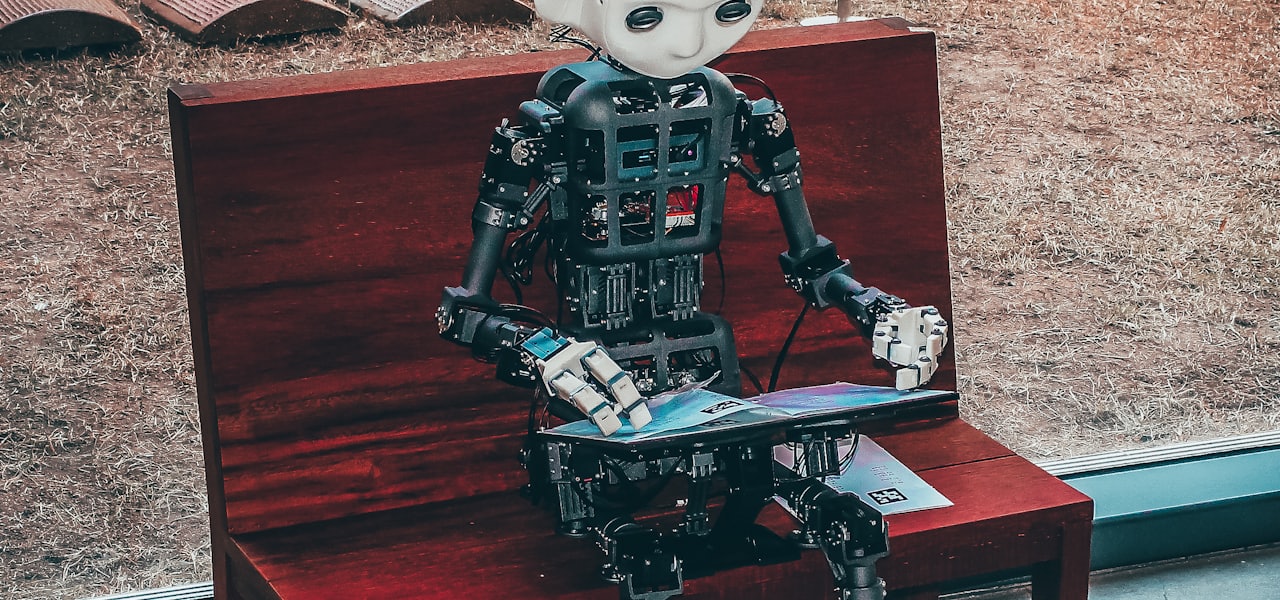
Model collapse, also known by other names such as "AI inbreeding", "AI cannibalism", "Habsburg AI", and "model autophagy disorder" or "MAD" is a phenomenon noted in artificial intelligence studies, where machine learning models gradually degrade due to errors coming from uncurated synthetic data, or due to training on the outputs of another model such as prior versions of itself. It is unclear to what extent the phenomenon threatens the long-term development of such models, and some techniques have been proposed to mitigate the effect. == Characteristics == Shumailov et al. coined the term to describe two specific stages to the degradation of machine learning models: early model collapse and late model collapse: In early model collapse, the model begins losing information about the tails of the distribution – mostly affecting minority data. Later work highlighted that early model collapse is hard to notice, since overall performance may appear to improve, while the model loses performance on minority data. In late model collapse, the model loses a significant proportion of its performance, confusing concepts and losing most of its variance. == Mechanism == Using synthetic data as training data can lead to issues with the quality and reliability of the trained model. Model collapse occurs for three main reasons: functional approximation errors sampling errors learning errors Importantly, it happens in even the simplest of models, where not all of the error sources are present. In more complex models the errors often compound, leading to faster collapse. == Disagreement over real-world impact == Some researchers and commentators on model collapse warn that the phenomenon could fundamentally threaten future generative AI development: As AI-generated data is shared on the Internet, it will inevitably end up in future training datasets, which are often crawled from the Internet. If training on "slop" (large quantities of unlabeled synthetic data) inevitably leads to model collapse, this could therefore pose a difficult problem. However, recently, other researchers have disagreed with this argument, showing that if synthetic data accumulates alongside human-generated data, model collapse is avoided. The researchers argue that data accumulating over time is a more realistic description of reality than deleting all existing data every year, and that the real-world impact of model collapse may not be as catastrophic as feared. An alternative branch of the literature investigates the use of machine learning detectors and watermarking to identify model generated data and filter it out. == Mathematical models of the phenomenon == === 1D Gaussian model === In 2024, a first attempt has been made at illustrating collapse for the simplest possible model — a single dimensional normal distribution fit using unbiased estimators of mean and variance, computed on samples from the previous generation. To make this more precise, we say that original data follows a normal distribution X 0 ∼ N ( μ , σ 2 ) {\displaystyle X^{0}\sim {\mathcal {N}}(\mu ,\sigma ^{2})} , and we possess M 0 {\displaystyle M_{0}} samples X j 0 {\displaystyle X_{j}^{0}} for j ∈ { 1 , … , M 0 } {\displaystyle j\in {\{\,1,\dots ,M_{0}\,{}\}}} . Denoting a general sample X j i {\displaystyle X_{j}^{i}} as sample j ∈ { 1 , … , M i } {\displaystyle j\in {\{\,1,\dots ,M_{i}\,{}\}}} at generation i {\displaystyle i} , then the next generation model is estimated using the sample mean and variance: μ i + 1 = 1 M i ∑ j X j i ; σ i + 1 2 = 1 M i − 1 ∑ j ( X j i − μ i + 1 ) 2 . {\displaystyle \mu _{i+1}={\frac {1}{M_{i}}}\sum _{j}X_{j}^{i};\quad \sigma _{i+1}^{2}={\frac {1}{M_{i}-1}}\sum _{j}(X_{j}^{i}-\mu _{i+1})^{2}.} Leading to a conditionally normal next generation model X j i + 1 | μ i + 1 , σ i + 1 ∼ N ( μ i + 1 , σ i + 1 2 ) {\displaystyle X_{j}^{i+1}|\mu _{i+1},\;\sigma _{i+1}\sim {\mathcal {N}}(\mu _{i+1},\sigma _{i+1}^{2})} . In theory, this is enough to calculate the full distribution of X j i {\displaystyle X_{j}^{i}} . However, even after the first generation, the full distribution is no longer normal: It follows a variance-gamma distribution. To continue the analysis, instead of writing the probability density function at each generation, it is possible to explicitly construct them in terms of independent random variables using Cochran's theorem. To be precise, μ 1 {\displaystyle \mu _{1}} and σ 1 {\displaystyle \sigma _{1}} are independent, with μ 1 ∼ N ( μ , σ 2 M 0 ) {\displaystyle \mu _{1}\sim {\mathcal {N}}\left(\mu ,{\frac {\sigma ^{2}}{M_{0}}}\right)} and ( M 0 − 1 ) σ 1 2 ∼ σ 2 Γ ( M 0 − 1 2 , 1 2 ) {\displaystyle (M_{0}-1)\,\sigma _{1}^{2}\sim \sigma ^{2}\,\Gamma \left({\frac {M_{0}-1}{2}},{\frac {1}{2}}\right)} , following a Gamma distribution. Denoting with Z {\displaystyle Z} Gaussian random variables distributed according to N ( 0 , 1 ) {\displaystyle {\mathcal {N}}(0,1)} and with S i {\displaystyle S^{i}} random variables distributed with 1 M i − 1 − 1 Γ ( M i − 1 − 1 2 , 1 2 ) {\displaystyle {\frac {1}{M_{i-1}-1}}\Gamma \left({\frac {M_{i-1}-1}{2}},{\frac {1}{2}}\right)} , it turns out to be possible to write samples at each generation as X j 0 = μ + σ Z j 0 , {\textstyle X_{j}^{0}=\mu +\sigma Z_{j}^{0},} X j 1 = μ + σ M 0 Z 1 + σ S 1 Z j 1 , {\textstyle X_{j}^{1}=\mu +{\frac {\sigma }{\sqrt {M_{0}}}}Z^{1}+\sigma {\sqrt {S^{1}}}Z_{j}^{1},} and more generally X j n = μ + σ M 0 Z 1 + σ M 1 S 1 Z 2 + ⋯ + σ M n − 1 S 1 × ⋯ × S n − 1 Z n + σ S 1 × ⋯ × S n Z j n . {\displaystyle X_{j}^{n}=\mu +{\frac {\sigma }{\sqrt {M_{0}}}}Z^{1}+{\frac {\sigma }{\sqrt {M_{1}}}}{\sqrt {S^{1}}}Z^{2}+\dots +{\frac {\sigma }{\sqrt {M_{n-1}}}}{\sqrt {S^{1}\times \dots \times S^{n-1}}}Z^{n}+\sigma {\sqrt {S^{1}\times \dots \times S^{n}}}Z_{j}^{n}.} Note, that these are not joint distributions, as Z n {\displaystyle Z^{n}} and S n {\displaystyle S^{n}} depend directly on Z j n − 1 {\displaystyle Z_{j}^{n-1}} , but when considering X j n {\displaystyle X_{j}^{n}} on its own the formula above provides all the information about the full distribution. To analyse the model collapse, we can first calculate variance and mean of samples at generation n {\displaystyle n} . This would tell us what kind of distributions we expect to arrive at after n {\displaystyle n} generations. It is possible to find its exact value in closed form, but the mean and variance of the square root of gamma distribution are expressed in terms of gamma functions, making the result quite clunky. Following, it is possible to expand all results to second order in each of 1 / M i {\displaystyle 1/M_{i}} , assuming each sample size to be large. It is then possible to show that 1 σ 2 Var ( X j n ) = 1 M 0 + 1 M 1 + ⋯ + 1 M n − 1 + 1 + O ( M i − 2 ) . {\displaystyle {\frac {1}{\sigma ^{2}}}\operatorname {Var} (X_{j}^{n})={\frac {1}{M_{0}}}+{\frac {1}{M_{1}}}+\dots +{\frac {1}{M_{n-1}}}+1+{\mathcal {O}}\left(M_{i}^{-2}\right).} And if all sample sizes M i = M {\displaystyle M_{i}=M} are constant, this diverges linearly as n → ∞ {\displaystyle n\to \infty } : Var ( X j n ) = σ 2 ( 1 + n M ) ; E ( X j n ) = μ . {\displaystyle \operatorname {Var} (X_{j}^{n})=\sigma ^{2}\left(1+{\frac {n}{M}}\right);\quad \mathbb {E} (X_{j}^{n})=\mu .} This is the same scaling as for a single dimensional Gaussian random walk. However, divergence of the variance of X j n {\displaystyle X_{j}^{n}} does not directly provide any information about the corresponding estimates of μ n + 1 {\displaystyle \mu _{n+1}} and σ n + 1 {\displaystyle \sigma _{n+1}} , particularly how different they are from the original μ {\displaystyle \mu } and σ {\displaystyle \sigma } . It turns out to be possible to calculate the distance between the true distribution and the approximated distribution at step n + 1 {\displaystyle n+1} , using the Wasserstein-2 distance (which is also sometimes referred to as risk): E [ W 2 2 ( N ( μ , σ 2 ) , N ( μ n + 1 , σ n + 1 2 ) ) ] = 3 2 σ 2 ( 1 M 0 + 1 M 1 + ⋯ + 1 M n ) + O ( M i − 2 ) , {\displaystyle \mathbb {E} \left[\mathbb {W} _{2}^{2}\left({\mathcal {N}}(\mu ,\sigma ^{2}),{\mathcal {N}}(\mu _{n+1},\sigma _{n+1}^{2})\right)\right]={\frac {3}{2}}\sigma ^{2}\left({\frac {1}{M_{0}}}+{\frac {1}{M_{1}}}+\dots +{\frac {1}{M_{n}}}\right)+{\mathcal {O}}\left(M_{i}^{-2}\right),} Var [ W 2 2 ( N ( μ , σ 2 ) , N ( μ n + 1 , σ n + 1 2 ) ) ] = 1 2 σ 4 ( 3 M 0 2 + 3 M 1 2 + ⋯ + 3 M n 2 + ∑ i ≠ j 4 M i M j ) + O ( M i − 3 ) . {\displaystyle \operatorname {Var} \left[\mathbb {W} _{2}^{2}\left({\mathcal {N}}(\mu ,\sigma ^{2}),{\mathcal {N}}(\mu _{n+1},\sigma _{n+1}^{2})\right)\right]={\frac {1}{2}}\sigma ^{4}\left({\frac {3}{M_{0}^{2}}}+{\frac {3}{M_{1}^{2}}}+\dots +{\frac {3}{M_{n}^{2}}}+\sum _{i\neq j}{\frac {4}{M_{i}M_{j}}}\right)+{\mathcal {O}}\left(M_{i}^{-3}\right).} This directly shows why model collapse occurs in this simple model. Due to errors from re-sampling the approximated distribution, each generation ends up corresponding to a
Big data
Big data primarily refers to data sets that are too large or complex to be dealt with by traditional data-processing software. Data with many entries (rows) offers greater statistical power, while data with higher complexity (more attributes or columns) may lead to a higher false discovery rate. Big data analysis challenges include capturing data, data storage, data analysis, search, sharing, transfer, visualization, querying, updating, information privacy, and data sources. Big data was originally associated with three key concepts: volume, variety, and velocity. The analysis of big data that have only volume, velocity, and variety can pose challenges in sampling. A fourth concept, veracity, which refers to the level of reliability of data, was thus added. Without sufficient investment in expertise to ensure big data veracity, the volume and variety of data can produce costs and risks that exceed an organization's capacity to create and capture value from big data. Current usage of the term big data tends to refer to the use of predictive analytics, user behavior analytics, or certain other advanced data analytics methods that extract value from big data, and seldom to a particular size of data set. "There is little doubt that the quantities of data now available are indeed large, but that's not the most relevant characteristic of this new data ecosystem." Analysis of data sets can find new correlations to "spot business trends, prevent diseases, combat crime and so on". Scientists, business executives, medical practitioners, advertising and governments alike regularly meet difficulties with large datasets in areas including Internet searches, fintech, healthcare analytics, geographic information systems, urban informatics, and business informatics. Scientists encounter limitations in e-Science work, including meteorology, genomics, connectomics, complex physics simulations, biology, and environmental research. The size and number of available data sets have grown rapidly as data is collected by devices such as mobile devices, cheap and numerous information-sensing Internet of things devices, aerial (remote sensing) equipment, software logs, cameras, microphones, radio-frequency identification (RFID) readers and wireless sensor networks. The world's technological per-capita capacity to store information has roughly doubled every 40 months since the 1980s; as of 2012, every day 2.5 exabytes (2.17×260 bytes) of data are generated. Based on an IDC report prediction, the global data volume was predicted to grow exponentially from 4.4 zettabytes to 44 zettabytes between 2013 and 2020. By 2025, IDC predicts there will be 163 zettabytes of data. According to IDC, global spending on big data and business analytics (BDA) solutions is estimated to reach $215.7 billion in 2021. Statista reported that the global big data market is forecasted to grow to $103 billion by 2027. In 2011 McKinsey & Company reported, if US healthcare were to use big data creatively and effectively to drive efficiency and quality, the sector could create more than $300 billion in value every year. In the developed economies of Europe, government administrators could save more than €100 billion ($149 billion) in operational efficiency improvements alone by using big data. And users of services enabled by personal-location data could capture $600 billion in consumer surplus. One question for large enterprises is determining who should own big-data initiatives that affect the entire organization. Relational database management systems and desktop statistical software packages used to visualize data often have difficulty processing and analyzing big data. The processing and analysis of big data may require "massively parallel software running on tens, hundreds, or even thousands of servers". What qualifies as "big data" varies depending on the capabilities of those analyzing it and their tools. Furthermore, expanding capabilities make big data a moving target. "For some organizations, facing hundreds of gigabytes of data for the first time may trigger a need to reconsider data management options. For others, it may take tens or hundreds of terabytes before data size becomes a significant consideration." == Definition == The term big data has been in use since the 1990s, with some giving credit to John Mashey for popularizing the term. Big data usually includes data sets with sizes beyond the ability of commonly used software tools to capture, curate, manage, and process data within a tolerable elapsed time. Big data philosophy encompasses unstructured, semi-structured and structured data; however, the main focus is on unstructured data. Big data "size" is a constantly moving target; as of 2012 ranging from a few dozen terabytes to many zettabytes of data. Big data requires a set of techniques and technologies with new forms of integration to reveal insights from datasets that are diverse, complex, and of a massive scale. Variability is often included as an additional quality of big data. A 2018 definition states "Big data is where parallel computing tools are needed to handle data", and notes, "This represents a distinct and clearly defined change in the computer science used, via parallel programming theories, and losses of some of the guarantees and capabilities made by Codd's relational model." In a comparative study of big datasets, Kitchin and McArdle found that none of the commonly considered characteristics of big data appear consistently across all of the analyzed cases. For this reason, other studies identified the redefinition of power dynamics in knowledge discovery as the defining trait. Instead of focusing on the intrinsic characteristics of big data, this alternative perspective pushes forward a relational understanding of the object claiming that what matters is the way in which data is collected, stored, made available and analyzed. === Big data vs. business intelligence === The growing maturity of the concept more starkly delineates the difference between "big data" and "business intelligence": Business intelligence uses applied mathematics tools and descriptive statistics with data with high information density to measure things, detect trends, etc. Big data uses mathematical analysis, optimization, inductive statistics, and concepts from nonlinear system identification to infer laws (regressions, nonlinear relationships, and causal effects) from large sets of data with low information density to reveal relationships and dependencies, or to perform predictions of outcomes and behaviors. == Characteristics == Big data can be described by the following characteristics: Volume The quantity of generated and stored data. The size of the data determines the value and potential insight, and whether it can be considered big data or not. The size of big data is usually larger than terabytes and petabytes. Variety The type and nature of the data. Earlier technologies like RDBMSs were capable to handle structured data efficiently and effectively. However, the change in type and nature from structured to semi-structured or unstructured challenged the existing tools and technologies. Big data technologies evolved with the prime intention to capture, store, and process the semi-structured and unstructured (variety) data generated with high speed (velocity), and huge in size (volume). Later, these tools and technologies were explored and used for handling structured data also but preferable for storage. Eventually, the processing of structured data was still kept as optional, either using big data or traditional RDBMSs. This helps in analyzing data towards effective usage of the hidden insights exposed from the data collected via social media, log files, sensors, etc. Big data draws from text, images, audio, video; plus it completes missing pieces through data fusion. Velocity The speed at which the data is generated and processed to meet the demands and challenges that lie in the path of growth and development. Big data is often available in real-time. Compared to small data, big data is produced more continually. Two kinds of velocity related to big data are the frequency of generation and the frequency of handling, recording, and publishing. Veracity The truthfulness or reliability of the data, which refers to the data quality and the data value. Big data must not only be large in size, but also must be reliable in order to achieve value in the analysis of it. The data quality of captured data can vary greatly, affecting an accurate analysis. Value The worth in information that can be achieved by the processing and analysis of large datasets. Value also can be measured by an assessment of the other qualities of big data. Value may also represent the profitability of information that is retrieved from the analysis of big data. Variability The characteristic of the changing formats, structure, or sources of big data. Big data can include structured, unstructured,
Automatic image annotation
Automatic image annotation (also known as automatic image tagging or linguistic indexing) is the process by which a computer system automatically assigns metadata in the form of captioning or keywords to a digital image. This application of computer vision techniques is used in image retrieval systems to organize and locate images of interest from a database. This method can be regarded as a type of multi-class image classification with a very large number of classes - as large as the vocabulary size. Typically, image analysis in the form of extracted feature vectors and the training annotation words are used by machine learning techniques to attempt to automatically apply annotations to new images. The first methods learned the correlations between image features and training annotations. Subsequently, techniques were developed using machine translation to attempt to translate the textual vocabulary into the 'visual vocabulary,' represented by clustered regions known as blobs. Subsequent work has included classification approaches, relevance models, and other related methods. The advantages of automatic image annotation versus content-based image retrieval (CBIR) are that queries can be more naturally specified by the user. At present, Content-Based Image Retrieval (CBIR) generally requires users to search by image concepts such as color and texture or by finding example queries. However, certain image features in example images may override the concept that the user is truly focusing on. Traditional methods of image retrieval, such as those used by libraries, have relied on manually annotated images, which is expensive and time-consuming, especially given the large and constantly growing image databases in existence.
Information
Information is an abstract concept that refers to something which has the power to inform. At the most fundamental level, it pertains to the interpretation (perhaps formally) of that which may be sensed, or their abstractions. Any natural process that is not completely random and any observable pattern in any medium can be said to convey some amount of information. Whereas digital signals and other data use discrete signs to convey information, other phenomena and artifacts such as analogue signals, poems, pictures, music or other sounds, and currents convey information in a more continuous form. Information is not knowledge itself, but the meaning that may be derived from a representation through interpretation. The concept of information is relevant to and connected with various concepts, including constraint, communication, control, data, form, education, knowledge, meaning, understanding, mental stimuli, pattern, perception, proposition, representation, and entropy. Information is often processed iteratively: Data available at one step are processed into information to be interpreted and processed at the next step. For example, in written text each symbol or letter conveys information relevant to the word it is part of, each word conveys information relevant to the phrase it is part of, each phrase conveys information relevant to the sentence it is part of, and so on until at the final step information is interpreted and becomes knowledge in a given domain. In a digital signal, bits may be interpreted into the symbols, letters, numbers, or structures that convey the information available at the next level up. The key characteristic of information is that it is subject to interpretation and processing. The derivation of information from a signal or message may be thought of as the resolution of ambiguity or uncertainty that arises during the interpretation of patterns within the signal or message. Information may be structured as data. Redundant data can be compressed up to an optimal size, which is the theoretical limit of compression. The information available through a collection of data may be derived by analysis. For example, a restaurant collects data from every customer order. That information may be analyzed to produce knowledge that is put to use when the business subsequently wants to identify the most popular or least popular dish. Information can be transmitted in time, via data storage, and space, via communication and telecommunication. Information is expressed either as the content of a message or through direct or indirect observation. That which is perceived can be construed as a message in its own right, and in that sense, all information is always conveyed as the content of a message. Information can be encoded into various forms for transmission and interpretation (for example, information may be encoded into a sequence of signs, or transmitted via a signal). It can also be encrypted for safe storage and communication. The uncertainty of an event is measured by its probability of occurrence. Uncertainty is proportional to the negative logarithm of the probability of occurrence. Information theory takes advantage of this by concluding that more uncertain events require more information to resolve their uncertainty. The bit is the standard unit of information. It is 'that which reduces uncertainty by half'. Other units such as the nat may be used. For example, the information encoded in one "fair" coin flip is log2(2/1) = 1 bit, and in two fair coin flips is log2(4/1) = 2 bits. A 2011 Science article estimates that 97% of technologically stored information was already in digital bits in 2007 and that the year 2002 was the beginning of the digital age for information storage (with digital storage capacity bypassing analogue for the first time). == Etymology and history of the concept == The English word "information" comes from Middle French enformacion/informacion/information 'a criminal investigation' and its etymon, Latin informatiō(n) 'conception, teaching, creation'. In English, "information" is an uncountable mass noun. References on "formation or molding of the mind or character, training, instruction, teaching" date from the 14th century in both English (according to Oxford English Dictionary) and other European languages. In the transition from Middle Ages to Modernity the use of the concept of information reflected a fundamental turn in epistemological basis – from "giving a (substantial) form to matter" to "communicating something to someone". Peters (1988, pp. 12–13) concludes: Information was readily deployed in empiricist psychology (though it played a less important role than other words such as impression or idea) because it seemed to describe the mechanics of sensation: objects in the world inform the senses. But sensation is entirely different from "form" – the one is sensual, the other intellectual; the one is subjective, the other objective. My sensation of things is fleeting, elusive, and idiosyncratic. For Hume, especially, sensory experience is a swirl of impressions cut off from any sure link to the real world... In any case, the empiricist problematic was how the mind is informed by sensations of the world. At first informed meant shaped by; later it came to mean received reports from. As its site of action drifted from cosmos to consciousness, the term's sense shifted from unities (Aristotle's forms) to units (of sensation). Information came less and less to refer to internal ordering or formation, since empiricism allowed for no preexisting intellectual forms outside of sensation itself. Instead, information came to refer to the fragmentary, fluctuating, haphazard stuff of sense. Information, like the early modern worldview in general, shifted from a divinely ordered cosmos to a system governed by the motion of corpuscles. Under the tutelage of empiricism, information gradually moved from structure to stuff, from form to substance, from intellectual order to sensory impulses. In the modern era, the most important influence on the concept of information is derived from the Information theory developed by Claude Shannon and others. This theory, however, reflects a fundamental contradiction. Northrup (1993) wrote: Thus, actually two conflicting metaphors are being used: The well-known metaphor of information as a quantity, like water in the water-pipe, is at work, but so is a second metaphor, that of information as a choice, a choice made by :an information provider, and a forced choice made by an :information receiver. Actually, the second metaphor implies that the information sent isn't necessarily equal to the information received, because any choice implies a comparison with a list of possibilities, i.e., a list of possible meanings. Here, meaning is involved, thus spoiling the idea of information as a pure "Ding an sich." Thus, much of the confusion regarding the concept of information seems to be related to the basic confusion of metaphors in Shannon's theory: is information an autonomous quantity, or is information always per SE information to an observer? Actually, I don't think that Shannon himself chose one of the two definitions. Logically speaking, his theory implied information as a subjective phenomenon. But this had so wide-ranging epistemological impacts that Shannon didn't seem to fully realize this logical fact. Consequently, he continued to use metaphors about information as if it were an objective substance. This is the basic, inherent contradiction in Shannon's information theory." (Northrup, 1993, p. 5). In their seminal book The Study of Information: Interdisciplinary Messages, Almach and Mansfield (1983) collected key views on the interdisciplinary controversy in computer science, artificial intelligence, library and information science, linguistics, psychology, and physics, as well as in the social sciences. Almach (1983, p. 660) himself disagrees with the use of the concept of information in the context of signal transmission, the basic senses of information in his view all referring "to telling something or to the something that is being told. Information is addressed to human minds and is received by human minds." All other senses, including its use with regard to nonhuman organisms as well to society as a whole, are, according to Machlup, metaphoric and, as in the case of cybernetics, anthropomorphic. Hjørland (2007) describes the fundamental difference between objective and subjective views of information and argues that the subjective view has been supported by, among others, Bateson, Yovits, Span-Hansen, Brier, Buckland, Goguen, and Hjørland. Hjørland provided the following example: A stone on a field could contain different information for different people (or from one situation to another). It is not possible for information systems to map all the stone's possible information for every individual. Nor is any one mapping the one "true" mapping. But peop
Online public access catalog
The online public access catalog (OPAC), now frequently synonymous with library catalog, is an online database of materials held by a library or group of libraries. Online catalogs have largely replaced the analog card catalogs previously used in libraries. == History == === Early online === Although a handful of experimental systems existed as early as the 1960s, the first large-scale online catalogs were developed at Ohio State University in 1975 and the Dallas Public Library in 1978. These and other early online catalog systems tended to closely reflect the card catalogs that they were intended to replace. Using a dedicated terminal or telnet client, users could search a handful of pre-coordinate indexes and browse the resulting display in much the same way they had previously navigated the card catalog. Throughout the 1980s, the number and sophistication of online catalogs grew. The first commercial systems appeared, and would by the end of the decade largely replace systems built by libraries themselves. Library catalogs began providing improved search mechanisms, including Boolean and keyword searching, as well as ancillary functions, such as the ability to place holds on items that had been checked-out. At the same time, libraries began to develop applications to automate the purchase, cataloging, and circulation of books and other library materials. These applications, collectively known as an integrated library system (ILS) or library management system, included an online catalog as the public interface to the system's inventory. Most library catalogs are closely tied to their underlying ILS system. === Stagnation and dissatisfaction === The 1990s saw a relative stagnation in the development of online catalogs. Although the earlier character-based interfaces were replaced with ones for the Web, both the design and the underlying search technology of most systems did not advance much beyond that developed in the late 1980s. At the same time, organizations outside of libraries began developing more sophisticated information retrieval systems. Web search engines like Google and popular e-commerce websites such as Amazon.com provided simpler to use (yet more powerful) systems that could provide relevancy ranked search results using probabilistic and vector-based queries. Prior to the widespread use of the Internet, the online catalog was often the first information retrieval system library users ever encountered. Now accustomed to web search engines, newer generations of library users have grown increasingly dissatisfied with the complex (and often arcane) search mechanisms of older online catalog systems. This has, in turn, led to vocal criticisms of these systems within the library community itself, and in recent years to the development of newer (often termed 'next-generation') catalogs. === Next-generation catalogs === Newer generations of library catalog systems, typically called discovery systems (or a discovery layer), are distinguished from earlier OPACs by their use of more sophisticated search technologies, including relevancy ranking and faceted search, as well as features aimed at greater user interaction and participation with the system, including tagging and reviews. These new features rely heavily on existing metadata which may be poor or inconsistent, particularly for older records. Newer catalog platforms may be independent of the organization's integrated library system (ILS), instead providing drivers that allow for the synchronization of data between the two systems. While the original online catalog interfaces were almost exclusively built by ILS vendors, libraries have increasingly sought next-generation catalogs built by enterprise search companies and open-source software projects, often led by libraries themselves. == Union catalogs == Although library catalogs typically reflect the holdings of a single library, they can also contain the holdings of a group or consortium of libraries. These systems, known as union catalogs, are usually designed to aid the borrowing of books and other materials among the member institutions via interlibrary loan. Examples of this type of catalogs include COPAC, SUNCAT, NLA Trove, and WorldCat—the last catalogs the collections of libraries worldwide. == Related systems == There are a number of systems that share much in common with library catalogs, but have traditionally been distinguished from them. Libraries utilize these systems to search for items not traditionally covered by a library catalog, although these systems are sometimes integrated into a more comprehensive discovery system. Bibliographic databases—such as Medline, ERIC, PsycINFO, Scopus, Web of Science, and many others—index journal articles and other research data. There are also a number of applications aimed at managing documents, photographs, and other digitized or born-digital items such as Digital Commons and DSpace. Particularly in academic libraries, these systems (often known as digital library systems or institutional repository systems) assist with efforts to preserve documents created by faculty and students. Electronic resource management helps librarians to track selection, acquisition, and licensing of a library's electronic information resources.
List of Ruby software and tools
This is a list of software and programming tools for the Ruby programming language, which includes libraries, web frameworks, implementations, tools, and related projects. == Web tools == Capistrano (software) – remote server automation tool Mongrel – Ruby web server Rack – interface between web servers and web applications Ruby on Rails – full-stack web application framework Sinatra – lightweight Ruby web application framework Spree Commerce – e-commerce platform WEBrick – Ruby HTTP server toolkit == Libraries == BioRuby – bioinformatics and computational biology library for Ruby Bogus – Ruby library for creating reliable test doubles with contract verification ERuby – embedded Ruby templating EventMachine – event-driven I/O library Factory Bot – test fixtures library Fat comma – Ruby library for JSON-like hash syntax Geocoder – Ruby library for geocoding and reverse geocoding addresses Haml – HTML templating engine Markaby – HTML generation via Ruby Nokogiri – XML/HTML parsing library RSpec – behavior-driven testing framework for Ruby RubyGems – package manager for Ruby libraries and applications Sass – CSS preprocessor Sidekiq – background job framework for Ruby, used to handle asynchronous tasks. Uconv – Unicode text conversion library Watir – web application testing framework == Ruby implementations == HotRuby – Ruby interpreter implemented in JavaScript, enabling Ruby code to run in web browsers. IronRuby – Ruby for .NET platform JRuby – Ruby on the Java Virtual Machine MacRuby – Ruby implementation for macOS Mod ruby – Apache module that embeds the Ruby interpreter to improve performance of Ruby web applications Mruby – lightweight Ruby interpreter Rubinius – alternative Ruby implementation, based loosely on the Smalltalk-80 Blue Book design. Ruby MRI – the standard Ruby interpreter YARV – "Yet Another Ruby VM," the bytecode interpreter used in modern Ruby implementations == Tools == Homebrew – package manager for macOS and Linux written in Ruby Pry – interactive Ruby shell Rake – build and task management Ruby Version Manager – environment manager RubyCocoa – bridge between Ruby and Cocoa RubyForge – project hosting site RubyMotion – for iOS/macOS development RubySpec – language specification tests == Integrated Development Environments == Aptana Studio — integrated RadRails plugin for Ruby on Rails development Eclipse DLTK Ruby Plugin — Ruby development plugin for Eclipse Eric — open-source Python-based IDE with Ruby support Komodo IDE — commercial cross-platform IDE with Ruby support RubyMine — commercial IDE for Ruby and Rails by JetBrains SlickEdit — commercial cross-platform IDE with Ruby support == List of websites using Ruby on Rails == Airbnb Basecamp Diaspora – decentralized social network application built with Ruby on Rails Discourse – open-source discussion platform built with Ruby on Rails Fiverr GitHub Hulu Shopify SoundCloud Twitch Zendesk
Linguistic categories
Linguistic categories include Lexical category, a part of speech such as noun, preposition, etc. Syntactic category, a similar concept which can also include phrasal categories Grammatical category, a grammatical feature such as tense, gender, etc. The definition of linguistic categories is a major concern of linguistic theory, and thus, the definition and naming of categories varies across different theoretical frameworks and grammatical traditions for different languages. The operationalization of linguistic categories in lexicography, computational linguistics, natural language processing, corpus linguistics, and terminology management typically requires resource-, problem- or application-specific definitions of linguistic categories. In Cognitive linguistics it has been argued that linguistic categories have a prototype structure like that of the categories of common words in a language. == Linguistic category inventories == To facilitate the interoperability between lexical resources, linguistic annotations and annotation tools and for the systematic handling of linguistic categories across different theoretical frameworks, a number of inventories of linguistic categories have been developed and are being used, with examples as given below. The practical objective of such inventories is to perform quantitative evaluation (for language-specific inventories), to train NLP tools, or to facilitate cross-linguistic evaluation, querying or annotation of language data. At a theoretical level, the existence of universal categories in human language has been postulated, e.g., in Universal grammar, but also heavily criticized. === Part-of-Speech tagsets === Schools commonly teach that there are 9 parts of speech in English: noun, verb, article, adjective, preposition, pronoun, adverb, conjunction, and interjection. However, there are clearly many more categories and sub-categories. For nouns, the plural, possessive, and singular forms can be distinguished. In many languages words are also marked for their case (role as subject, object, etc.), grammatical gender, and so on; while verbs are marked for tense, aspect, and other things. In some tagging systems, different inflections of the same root word will get different parts of speech, resulting in a large number of tags. For example, NN for singular common nouns, NNS for plural common nouns, NP for singular proper nouns (see the POS tags used in the Brown Corpus). Other tagging systems use a smaller number of tags and ignore fine differences or model them as features somewhat independent from part-of-speech. In part-of-speech tagging by computer, it is typical to distinguish from 50 to 150 separate parts of speech for English. POS tagging work has been done in a variety of languages, and the set of POS tags used varies greatly with language. Tags usually are designed to include overt morphological distinctions, although this leads to inconsistencies such as case-marking for pronouns but not nouns in English, and much larger cross-language differences. The tag sets for heavily inflected languages such as Greek and Latin can be very large; tagging words in agglutinative languages such as Inuit languages may be virtually impossible. Work on stochastic methods for tagging Koine Greek (DeRose 1990) has used over 1,000 parts of speech and found that about as many words were ambiguous in that language as in English. A morphosyntactic descriptor in the case of morphologically rich languages is commonly expressed using very short mnemonics, such as ncmsan for category = noun, type = common, gender = masculine, number = singular, case = accusative, animate = no. The most popular tag set for POS tagging for American English is probably the Penn tag set, developed in the Penn Treebank project. === Multilingual annotation schemes === For Western European languages, cross-linguistically applicable annotation schemes for parts-of-speech, morphosyntax and syntax have been developed with the EAGLES Guidelines. The "Expert Advisory Group on Language Engineering Standards" (EAGLES) was an initiative of the European Commission that ran within the DG XIII Linguistic Research and Engineering programme from 1994 to 1998, coordinated by Consorzio Pisa Ricerche, Pisa, Italy. The EAGLES guidelines provide guidance for markup to be used with text corpora, particularly for identifying features relevant in computational linguistics and lexicography. Numerous companies, research centres, universities and professional bodies across the European Union collaborated to produce the EAGLES Guidelines, which set out recommendations for de facto standards and rules of best practice for: Large-scale language resources (such as text corpora, computational lexicons and speech corpora); Means of manipulating such knowledge, via computational linguistic formalisms, mark up languages and various software tools; Means of assessing and evaluating resources, tools and products. The Eagles guidelines have inspired subsequent work on other regions, as well, e.g., Eastern Europe. A generation later, a similar effort was initiated by the research community under the umbrella of Universal Dependencies. Petrov et al. have proposed a "universal", but highly reductionist, tag set, with 12 categories (for example, no subtypes of nouns, verbs, punctuation, etc.; no distinction of "to" as an infinitive marker vs. preposition (hardly a "universal" coincidence), etc.). Subsequently, this was complemented with cross-lingual specifications for dependency syntax (Stanford Dependencies), and morphosyntax (Interset interlingua, partially building on the Multext-East/Eagles tradition) in the context of the Universal Dependencies (UD), an international cooperative project to create treebanks of the world's languages with cross-linguistically applicable ("universal") annotations for parts of speech, dependency syntax, and (optionally) morphosyntactic (morphological) features. Core applications are automated text processing in the field of natural language processing (NLP) and research into natural language syntax and grammar, especially within linguistic typology. The annotation scheme has it roots in three related projects: The UD annotation scheme uses a representation in the form of dependency trees as opposed to a phrase structure trees. At as of February 2019, there are just over 100 treebanks of more than 70 languages available in the UD inventory. The project's primary aim is to achieve cross-linguistic consistency of annotation. However, language-specific extensions are permitted for morphological features (individual languages or resources can introduce additional features). In a more restricted form, dependency relations can be extended with a secondary label that accompanies the UD label, e.g., aux:pass for an auxiliary (UD aux) used to mark passive voice. The Universal Dependencies have inspired similar efforts for the areas of inflectional morphology, frame semantics and coreference. For phrase structure syntax, a comparable effort does not seem to exist, but the specifications of the Penn Treebank have been applied to (and extended for) a broad range of languages, e.g., Icelandic, Old English, Middle English, Middle Low German, Early Modern High German, Yiddish, Portuguese, Japanese, Arabic and Chinese. === Conventions for interlinear glosses === In linguistics, an interlinear gloss is a gloss (series of brief explanations, such as definitions or pronunciations) placed between lines (inter- + linear), such as between a line of original text and its translation into another language. When glossed, each line of the original text acquires one or more lines of transcription known as an interlinear text or interlinear glossed text (IGT)—interlinear for short. Such glosses help the reader follow the relationship between the source text and its translation, and the structure of the original language. There is no standard inventory for glosses, but common labels are collected in the Leipzig Glossing Rules. Wikipedia also provides a List of glossing abbreviations that draws on this and other sources. === General Ontology for Linguistic Description (GOLD) === GOLD ("General Ontology for Linguistic Description") is an ontology for descriptive linguistics. It gives a formalized account of the most basic categories and relations used in the scientific description of human language, e.g., as a formalization of interlinear glosses. GOLD was first introduced by Farrar and Langendoen (2003). Originally, it was envisioned as a solution to the problem of resolving disparate markup schemes for linguistic data, in particular data from endangered languages. However, GOLD is much more general and can be applied to all languages. In this function, GOLD overlaps with the ISO 12620 Data Category Registry (ISOcat); it is, however, more stringently structured. GOLD was maintained by the LINGUIST List and others from 2007 to 2010. The RELISH project created a mirro